


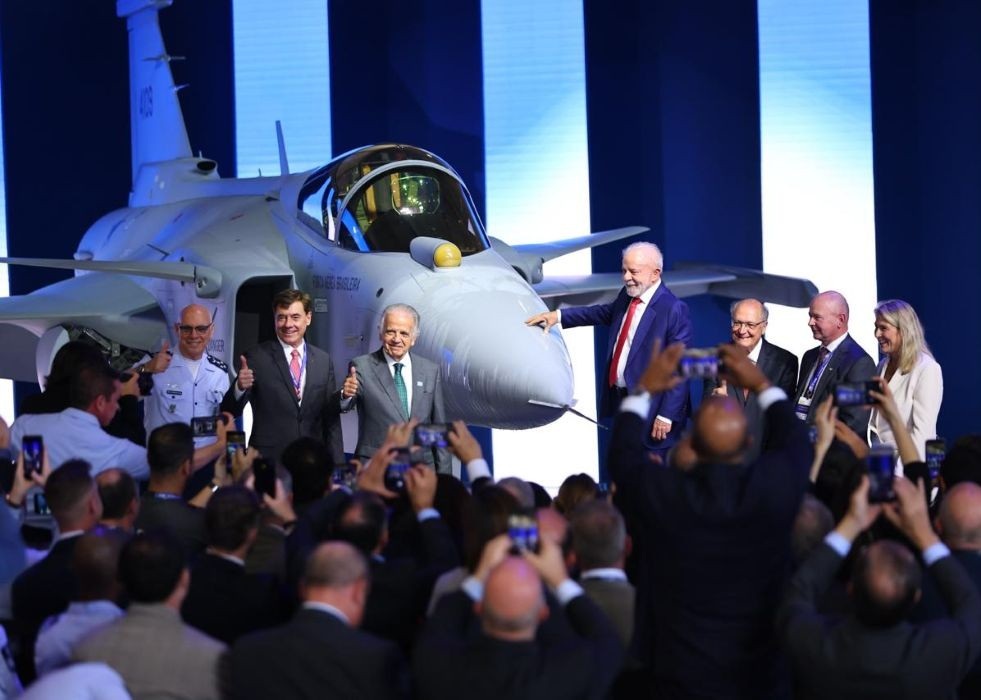
Brazil’s fighter transition is entering a sensitive phase as the Brazilian Air Force (FAB) prepares to retire its A-1 AMX attack aircraft while deliveries of the newer F-39E Gripen stretch into the next decade.
The immediate pressure is clearest in Santa Maria, a city in Rio Grande do Sul, Brazil’s southernmost state. The local air base has long operated the A-1, Brazil’s designation for the AMX, an Italian-Brazilian ground-attack aircraft used for strike and tactical reconnaissance missions.
A Base Without a Decision
Diário de Santa Maria reported in March 2026 that the A-1 is expected to fly until the end of its planned service life in 2027, but that the FAB had not yet chosen a successor for the aircraft at Santa Maria Air Base. Colonel Aviator Arthur Ribas Teixeira, the base commander, told the newspaper that the Air Force was still studying alternatives through meetings at the Air Force General Staff.
Teixeira also rejected speculation that the A-29 Super Tucano, Embraer’s turboprop light-attack aircraft, could temporarily replace the A-1 at Santa Maria. He said the aircraft has a different role and different performance profile from the A-1.
The A-1 has been present in Santa Maria since 1989. According to Diário de Santa Maria, it has been used in missions including attacks with bombs, rockets and cannons, tactical reconnaissance, readiness operations, border-area surveillance and operations against clandestine airstrips in the Amazon.
Strategic Concerns
DefesaNet, a Brazilian defense publication, argued in a May 2026 commentary that removing the A-1s without a fighter replacement would create a serious operational gap in Brazil’s southern airpower. The outlet said Santa Maria’s location gives it strategic value for territorial defense, regional deterrence and deep-strike operations in the Southern Cone.
That assessment is advocacy, not an official FAB statement. But it reflects a broader concern present across the sources: Brazil risks retiring older combat aircraft before its new Gripen fleet is large enough to cover all missions.
The FAB is also phasing out the F-5M Tiger II, an upgraded version of the Northrop F-5 that has served as a backbone of Brazilian air defense for decades. Zona Militar reported that the service has considered acquiring 12 second-hand Gripen C/D fighters from Sweden as an interim measure while the F-39E/F program advances.
The Gripen Delay
Brazil selected Saab’s Gripen E/F in 2014 under the F-X2 fighter program, choosing it over Dassault’s Rafale and Boeing’s F/A-18E/F Super Hornet. The original contract covered 36 aircraft, including 28 single-seat Gripen E jets, designated F-39E in Brazilian service, and eight two-seat Gripen F aircraft.
The program also includes technology transfer and local industrial work with Embraer. Turdef reported that Brazil rolled out the first supersonic fighter assembled in Latin America at Embraer’s Gavião Peixoto facility in São Paulo state in March 2026. The aircraft remains a Swedish design, but final assembly and systems integration in Brazil mark a milestone for the country’s defense industry.
Still, the schedule has slipped. Zona Militar reported that deliveries are now expected to extend until 2032. Global Defense Corp, citing Folha de S.Paulo, reported that Brazil and Sweden had discussed up to 12 used Gripen C/Ds as a temporary solution after a September 2025 visit to Stockholm by FAB commander Lieutenant Brigadier Marcelo Kanitz Damasceno.
No source cited a final purchase decision. Global Defense Corp said the talks were not detailed in the public bilateral defense declaration, which emphasized Sweden’s purchase of four Embraer KC-390 transport aircraft.
For Brazil, the choice is now practical as much as strategic. It can wait for the F-39E/F fleet to mature, seek a stopgap such as used Gripens, or accept a period in which older aircraft leave service faster than new fighters arrive. Santa Maria is where that national dilemma is becoming visible first.