


Brazil’s armed forces are facing a familiar procurement dilemma: wait for advanced systems that match long-term ambitions, or accept less-than-perfect options to preserve operational capacity now. Recent reporting and commentary in Brazilian defense media point to the same pressure across the Air Force and Army: aging fleets, constrained budgets and slow replacement cycles.
DefesaNet framed the issue as the “Ferrari dilemma”: the pursuit of the best possible platform can become a reason to delay decisions until existing capabilities fade. The outlet’s commentary argued that Brazil’s defense planning has repeatedly struggled to balance ambition with fiscal reality.
Air Force Pressure
The Brazilian Air Force (FAB) has invested in the F-39 Gripen E/F, the Swedish-designed fighter produced by Saab with Brazilian industrial participation. The program is central to replacing older fighter capacity, but the current contract covers 36 aircraft, a number defense outlets describe as insufficient for a country of Brazil’s size.
Sociedade Militar, citing earlier DefesaNet reporting, said the FAB has discussed internally whether it can continue operating two F-5M fighter squadrons at the same time. The two units named in the report are the 1st/14th Aviation Group “Pampa,” based in Canoas in Rio Grande do Sul, and the 1st Fighter Aviation Group “Jambock,” based at Santa Cruz in Rio de Janeiro.
That account is based on defense-sector reporting rather than an official FAB announcement. Still, the concern is clear: Brazil’s F-5M jets are modernized versions of aircraft whose original design dates to the 1960s, and the supply of parts and airworthy airframes is becoming harder to sustain.
The AMX Gap
A second aviation issue involves the AMX A-1M, Brazil’s long-serving tactical attack aircraft, developed through an Italian-Brazilian partnership and modernized by Embraer. AeroJota reported that the FAB is evaluating the Leonardo M-346FA, an armed version of an Italian advanced trainer, as a possible replacement for AMX missions.
According to the report, which cites Revista ASAS, the number under discussion could reach 36 aircraft, though there is no official confirmation from the FAB, Brazil’s Ministry of Defense or Leonardo. The M-346FA would not replace the Gripen in high-end air-defense missions. Its appeal would be lower-cost attack, advanced training and support roles that could preserve Gripen flight hours for more demanding missions.
Tanks and Trade-Offs
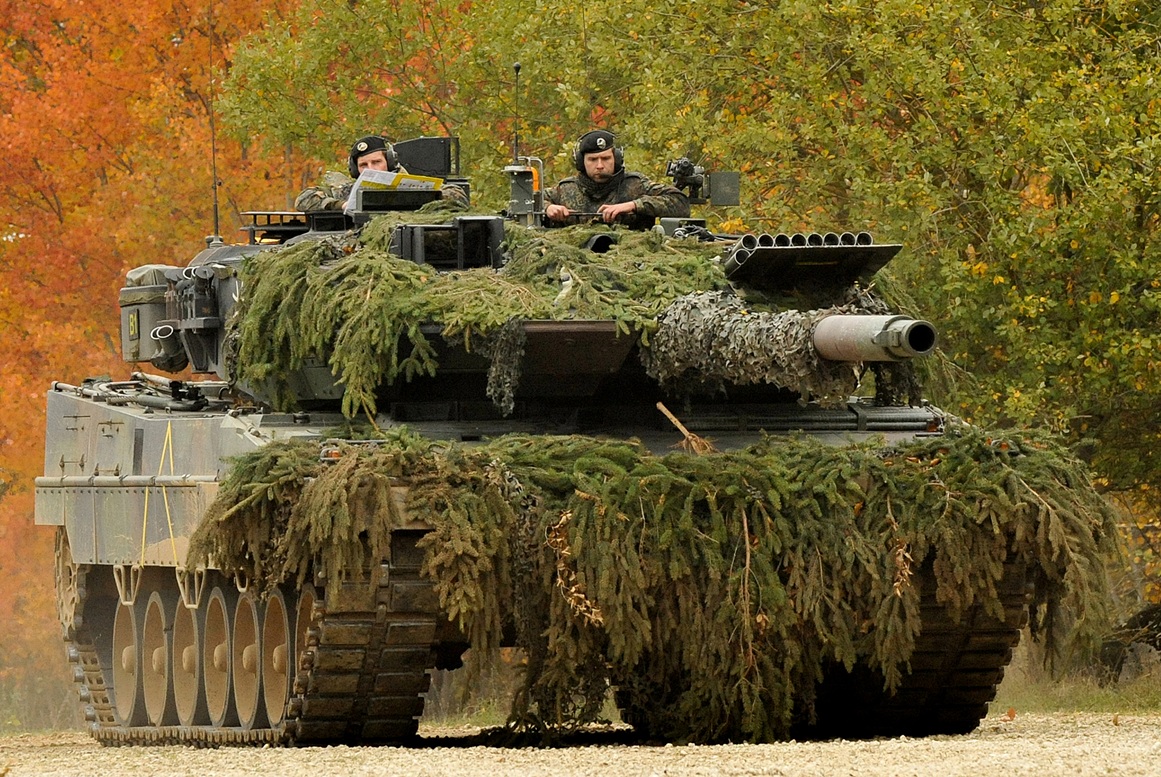
The Army faces a parallel debate over tracked armored vehicles. Tecnodefesa reported that Germany offered Brazil 65 Leopard 2A6 main battle tanks and 78 Marder 1A5 infantry fighting vehicles from German Army stocks, with refurbishment by KNDS Deutschland. Forte also reported the offer, noting that no contract has been signed and that Brazil is still evaluating the technical, industrial, logistical and financial implications.
The proposal is linked to Brazil’s “New Family of Tracked Armored Vehicles” program, designed to renew the Army’s armored force and replace platforms such as the Leopard 1A5BR. Tecnodefesa said the Army’s published requirement for the new tank calls for a combat-ready weight below 50 metric tons, while the Leopard 2A6 weighs about 62.3 metric tons. That would imply extra spending on transport, maintenance, infrastructure and support vehicles.
Tecnodefesa also reported estimated costs of about €15 million per Leopard 2A6 and €10 million per Marder, excluding support. It argued that such prices would weaken the case for buying older vehicles instead of newer contenders such as ASCOD, CV90, Lynx or Tulpar. Forte’s coverage was more cautious, stressing that the package remains under analysis and that refurbishment terms would be decisive.
A Strategic Choice
Taken together, the reports show a defense establishment caught between two risks. Buying interim or second-hand systems can lock Brazil into expensive logistics and foreign suppliers. Waiting too long can leave pilots, crews and units without enough usable equipment to sustain training and readiness.
The question for Brazil is therefore not only which aircraft or armored vehicle is technically superior. It is which mix of systems the country can buy in sufficient numbers, maintain over decades and integrate with its industrial base without losing current capability during the transition.