


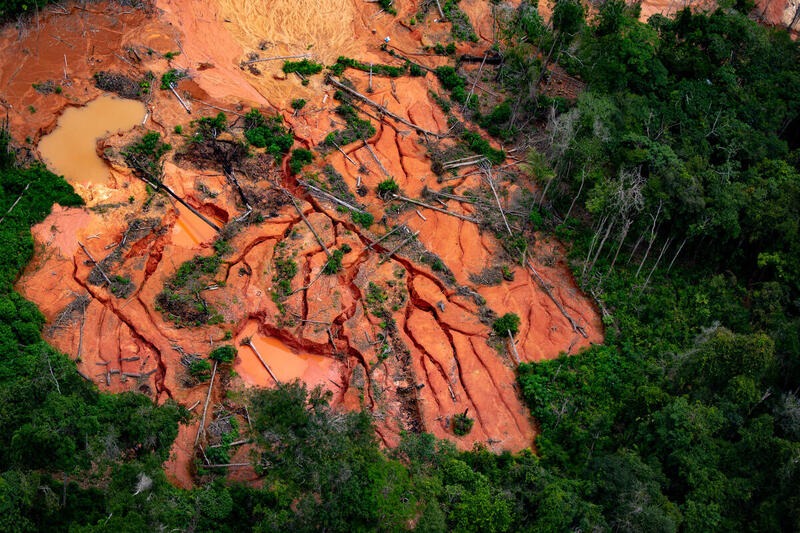
Illegal gold from Brazil’s Amazon is still moving through the formal market with the help of mining permits tied to areas where little or no mining appears to have taken place, according to a new Greenpeace Brazil investigation reported by Reuters and Brazilian outlets.
The group says the scheme uses Permissões de Lavra Garimpeira, or PLGs, a Brazilian permit category created for small-scale gold mining and issued by the National Mining Agency (ANM). In practice, Greenpeace argues, some permits have become paperwork fronts that allow gold mined in protected areas or Indigenous territories to be sold as legal metal.
What Greenpeace Found
Greenpeace said it examined 187 mining processes in Amazon areas of Pará, Mato Grosso and Rondônia from 2018 to 2026. Its own summary says 98 PLGs showed serious irregularities and concentrated 97% of the gold declared in the sample.
There is a discrepancy in the figures published from the investigation. Greenpeace’s blog says the irregular PLGs accounted for 25.3 metric tons of gold, worth about R$18.4 billion in May 2026 values. Reuters, cited by Valor Econômico and Olhar Digital, reported 26.8 metric tons valued at about USD 3.88 billion between 2018 and March 2026.
Both accounts describe the same core mechanism: permits linked to “ghost mines,” where declared production was incompatible with satellite images or field observations, and operations that appeared industrial in scale despite being structured through multiple small-mining permits.
How the Laundering Works
Under Brazil’s current gold-trading system, a miner can sell gold to authorized financial dealers and declare the origin of the metal by identifying a PLG. Earlier reporting by Deutsche Welle, citing specialists, described the process as heavily dependent on self-declaration and weak traceability.
That gap matters because gold is easy to move and difficult to trace once it enters the financial chain. If a permit lists production from a legal site that did not actually produce the declared volume, investigators suspect the metal may have come from illegal pits elsewhere, including Indigenous lands and conservation units.
Reuters said its journalists flew over two licensed sites included in Greenpeace’s dataset and saw no visible mining activity despite documentation indicating major open-pit production. Six minutes away by air, they observed a large illegal mining operation inside a protected area.
Indigenous Lands and Enforcement
Researchers and investigators cited in the reports believe much of the gold linked to suspicious permits may have come from protected areas and Indigenous territories, including lands associated with the Kayapó people in Pará. Kayapó chief Megaron Txucarramae told Reuters that illegal mining destroys land, pollutes rivers and leaves Indigenous communities eating contaminated fish.
The allegations come despite efforts by President Luiz Inácio Lula da Silva’s federal government to curb illegal mining since he returned to office in 2023. Reuters reported that Brazil’s Federal Police seized a record 447 kg of illegally mined gold last year.
The ANM said it is monitoring the permits cited by Greenpeace for irregularities. The agency also said the Amazon’s large number of mining authorizations creates major logistical and enforcement challenges.
Greenpeace says the problem will continue as long as permits can be used to make illegal gold appear legitimate. Specialists cited by DW and Minasinforma argue that Brazil needs stronger gold traceability, better integration of federal databases and electronic systems capable of following the metal from extraction to sale.