


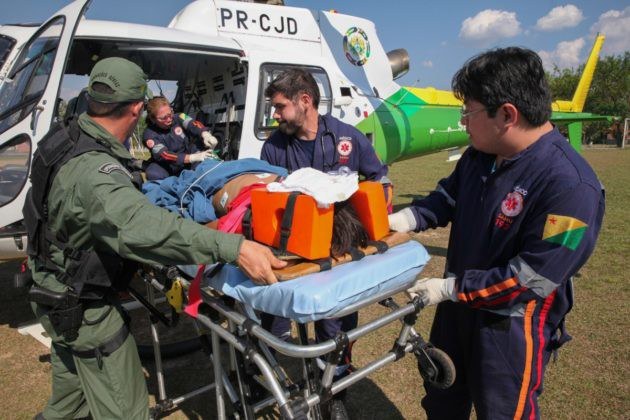
Brazil’s Federal Public Prosecutor’s Office (MPF) has asked a federal court to order the federal government to restore helicopter transport for Indigenous health services in Acre, a remote Amazonian state on Brazil’s western border. Prosecutors say the interruption has isolated villages, delayed medical evacuations and created what they called a situation of “serious lack of health assistance” in the Alto Rio Juruá Special Indigenous Health District.
The civil action seeks at least 600 hours of helicopter flight time for the district, to be made available within 15 days. The MPF also asks for a daily fine of R$10,000 if the order is not followed.
What Prosecutors Allege
The Alto Rio Juruá district serves about 22,000 Indigenous people in more than 164 villages spread across 21 river basins, according to the MPF. The area includes 15 Indigenous peoples, among them the Ashaninka, Huni Kuĩ, Yawanawá, Noke Kuĩ, Shawãdawa, Puyanawa and Nukini, as well as communities described as being of recent contact.
Many of the villages have no regular road access. Health teams depend on river and air transport for emergency removals, vaccination, basic care and the delivery of medicines, dental material and other supplies.
The MPF says the helicopter service used by the district expired on November 21, 2025, and that available flight hours have since run out. A new procurement process was sent in January 2026 to Sesai, the Indigenous Health Secretariat within Brazil’s Health Ministry, but prosecutors say it remains stalled in Brasília without a concrete hiring date.
Delays and Child Deaths
According to data cited in the lawsuit, at least 15 emergency evacuation requests were not carried out after the air service stopped. Another 37 took place with delays that prosecutors described as critical.
The lawsuit also says the interruption affected the work of multidisciplinary Indigenous health teams and the regular transport of vaccines and medicines. A technical report cited by the MPF said the population faced a “strong impact of care vacuum,” with preventable cases worsening because of inadequate treatment.
Prosecutors link the wider lack of care to a rise in deaths among Indigenous infants in the region. The action says at least 17 Indigenous children under the age of one died in 2026 in the territory covered by the Alto Rio Juruá district, many from conditions classified as avoidable, including infections, malnutrition, gastroenteritis, respiratory illness and severe dehydration.
Why the Timing Matters
The situation could worsen during the Amazon dry season, usually between July and October, when river levels in Acre fall sharply. In that period, prosecutors say, some communities become unreachable by boat, making helicopters the only practical way to handle urgent medical removals and maintain basic health services.
The MPF argues that the crisis reflects planning failures rather than an unforeseeable emergency. It says federal authorities could have used emergency contracting rules to avoid the interruption of an essential public service.
The case is also not new. In 2024, a federal court had already ordered emergency flight-hour contracting after a similar interruption in services for Indigenous communities in the region. Prosecutors say the repetition points to structural problems in the federal management of Indigenous health in Acre.
Government Response
G1 reported that it contacted the Alto Rio Juruá health district and was awaiting a response. Acre’s state health department told the outlet that rescues of serious patients continue whenever the state is called, through cooperation between public security agencies and Brazil’s mobile emergency service, Samu.
The state department also said Indigenous health management and village transport logistics are the responsibility of the federal Indigenous health district, not the state government. The MPF’s request remains focused on compelling the federal government to restore air support for the district.