
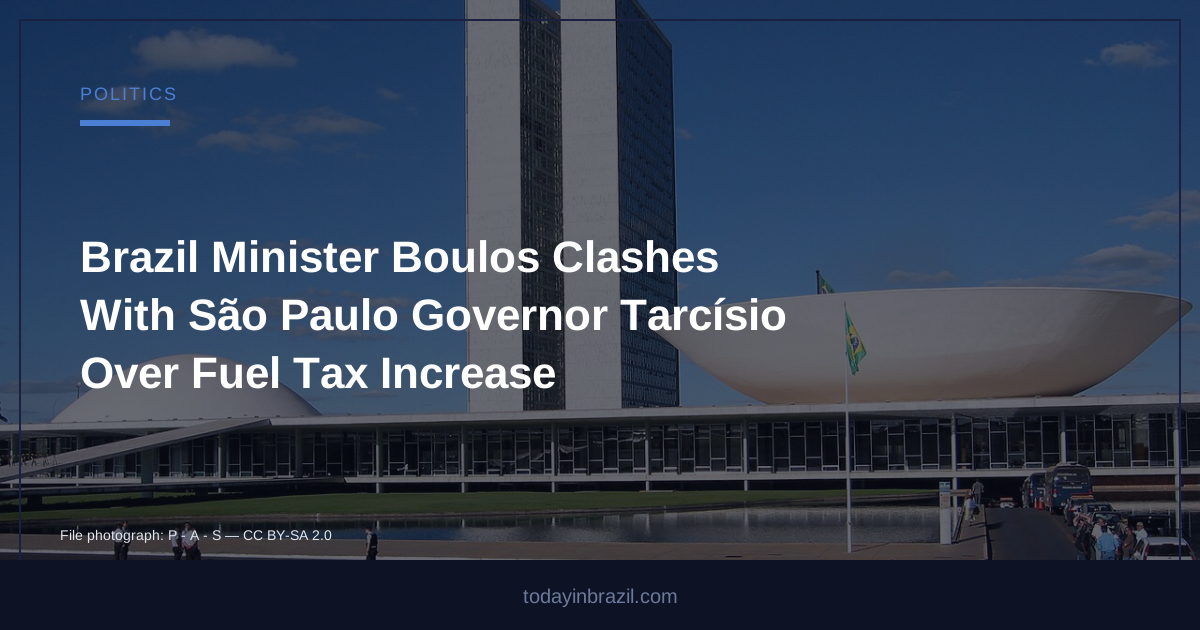
Brazil's Minister of the General Secretariat of the Presidency, Guilherme Boulos (PSOL), and São Paulo Governor Tarcísio de Freitas (Republicanos) exchanged public criticisms on Sunday over an increase in the ICMS state tax on fuels set to take effect in February 2027.
Boulos posted a video on social media accusing Tarcísio of raising the diesel tax from R$ 1.17 to R$ 1.30 per liter — an increase of more than 10% — while President Luiz Inácio Lula da Silva's (PT) federal government maintains a subsidy of R$ 2.12 per liter to contain pump prices. "The governor of São Paulo decided to increase the state tax on diesel by more than 1%," Boulos said. "While Lula, who they said 'would raise taxes,' is holding the diesel price down to avoid increasing the cost of living, Tarcísio is raising the tax." He called the move "hypocrisy and political opportunism" inconsistent with Tarcísio's campaign rhetoric against federal tax increases.
Tarcísio responded with a statement saying the ICMS adjustment was not a unilateral São Paulo decision but a unanimous resolution of the National Council of Finance Policy (Confaz), a collegiate body presided over by Finance Minister Dario Durigan and composed of finance secretaries from all 26 states and the Federal District. The council approved the measure on October 27 — three days after the presidential runoff — citing "global instability in petroleum derivative prices." The new rates apply to diesel, gasoline, and cooking gas nationwide.
In his rebuttal, Tarcísio noted that the ratification included representatives of PT-governed states. He added that São Paulo has kept its modal ICMS rate at 18% for the past four years — one of the lowest in the country — while states governed by the PT have raised theirs: Piauí to 22.5%, Bahia to 20.5%, and Ceará to 20%. São Paulo also expanded ICMS exemptions on food products and eliminated the IPVA vehicle tax for motorcycles up to 180cc.
The federal government, for its part, announced on October 27 the extension for 30 days of the diesel subsidy created in April to offset effects of the Iran conflict. The Planalto reported the total cost of fuel subsidies exceeded R$ 32 billion (approximately USD 6.1 billion at recent rates, approximate conversion) as of late August.
Both sides accuse the other of distorting facts for political gain. Boulos frames the increase as a betrayal of Tarcísio's anti-tax campaign platform; Tarcísio frames Boulos's criticism as disinformation from a minister who should "clarify the population, not spread disinformation." The dispute highlights tensions between the federal administration and Brazil's most populous state ahead of the 2026 electoral cycle.