


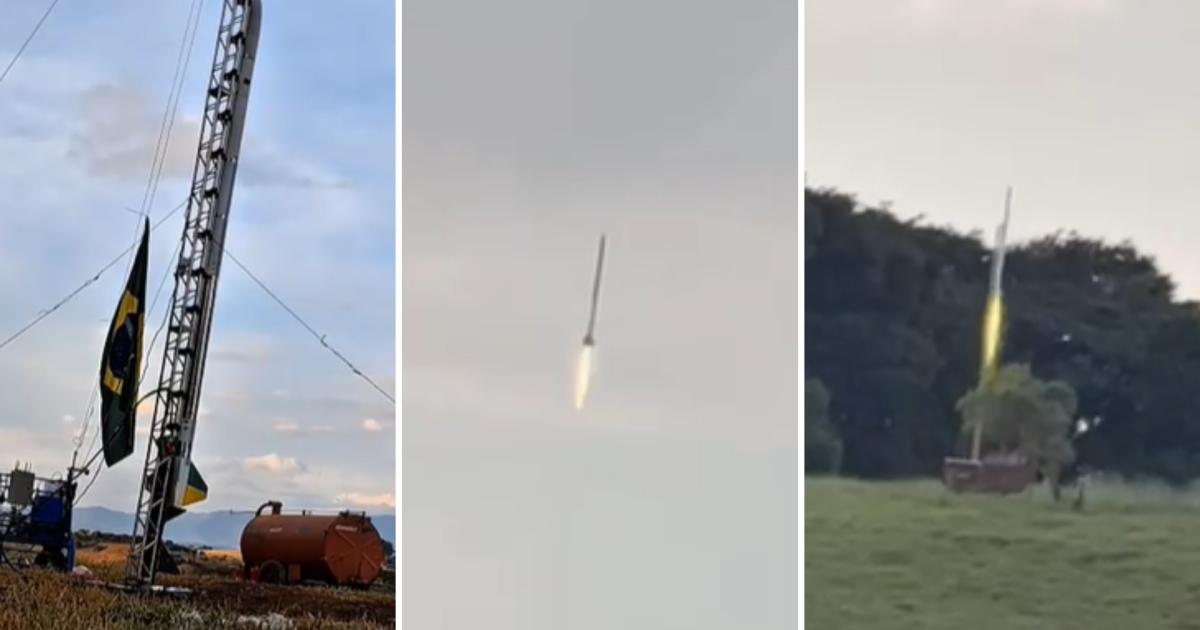
Brazil has launched, for the first time, a rocket powered exclusively by liquid propulsion from liftoff, according to single-source reporting from CNN Brasil. The FTL-Perseu rocket flew on May 29 in Virgínia, a municipality in the southeastern state of Minas Gerais, with the mission announced as completed on July 4.
The vehicle was developed entirely by BIZU Space, a Brazilian aerospace company based in São José dos Campos, a city in São Paulo state known for its aeronautics and space industry. The launch aimed to validate ARION, the company's liquid rocket engine, a technology considered important for more complex future space missions.
Why Liquid Propulsion Matters
Liquid propulsion differs from the solid-fuel systems widely used in training and sounding rockets. Liquid engines can offer greater control over thrust during flight, a feature used in launch vehicles designed to place satellites in orbit and carry out more precise maneuvers.
The FTL-Perseu is about 4.5 meters long (nearly 15 feet) and weighs roughly 70 kilograms (154 pounds) when fueled. For the inaugural flight, BIZU Space used Jet-A aviation kerosene as fuel and concentrated hydrogen peroxide, known as HTP, as the oxidizer.
According to the company, the fuel combination avoids cryogenic propellants, which require extremely low storage temperatures. BIZU Space also says the oxidizer's decomposition mainly produces water and oxygen, reducing environmental impact compared with some other propulsion systems.
A Reduced-Risk First Flight
The project is designed for the rocket to reach up to 10,000 meters (about 32,800 feet) in its nominal configuration. The first flight, however, used a reduced propellant load, a common approach in development campaigns to test systems while lowering risk in early operations.
After launch, the vehicle was successfully recovered using a parachute and tracking system, according to CNN Brasil. The rocket is now at BIZU Space's headquarters in São José dos Campos, where it will undergo technical analysis and may be reused in future test campaigns.
BIZU Space named the operation “Missão Trem Baum,” a reference to a common expression in Minas Gerais culture. The company says the successful mission places Brazil among a restricted group of countries that master liquid-propulsion rocket technology.
Brazil's Longer Effort
The launch also comes during the centenary year of a key milestone in rocketry. In 1926, American physicist Robert H. Goddard launched Nell, widely considered the first liquid-propellant rocket in history.
Brazilian work on liquid propulsion dates back to the 1990s, with research conducted by the Institute of Aeronautics and Space (IAE), a Brazilian aerospace research body. In 2014, Operation Raposa carried out the first flight of a liquid engine as an onboard payload in a solid-propellant rocket.
The FTL-Perseu project began in 2025 and involved institutions including CENIC, the University of Vale do Paraíba (UNIVAP), the Technological Institute of Aeronautics (ITA), and the Brazilian Astronomy Olympiad (OBA). BIZU Space says the mission opens a path toward more complex launch vehicles and could expand Brazil's autonomy in access to space.