


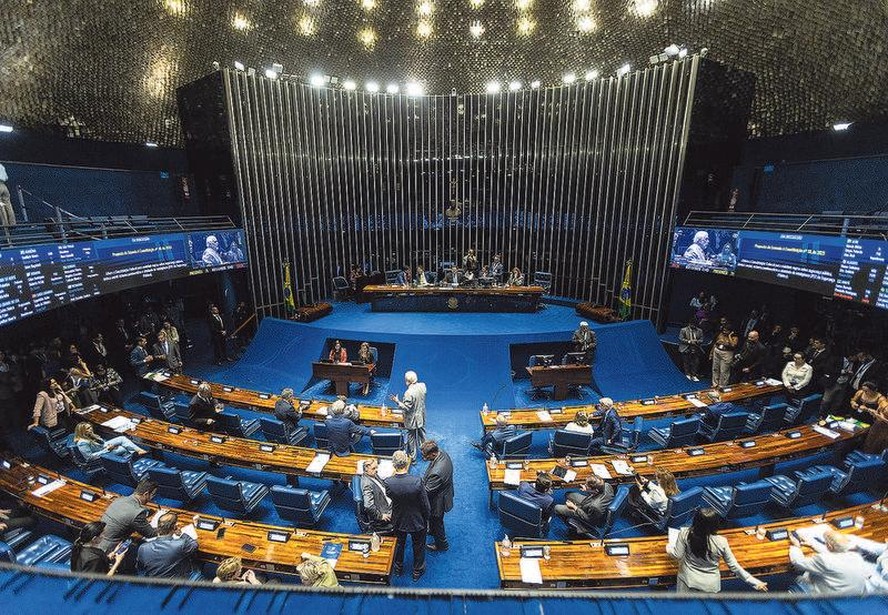
Brazil's Senate postponed a vote on four proposed changes to the government's fiscal adjustment bill on Tuesday after the administration of President Luiz Inácio Lula da Silva failed to secure enough votes to protect its core revenue-raising measure. The delay pushes the decision to Wednesday and clouds the timeline for a package the government says could save 45.1 billion to 56.1 billion reais (roughly USD 8.2 billion to 10.2 billion at recent rates) in 2027.
The sticking point
The central dispute concerns a provision that would let the executive limit corporate tax credits — known as "tax compensations" — whenever it orders extra spending cuts to hit the center of its fiscal target. Companies use these credits, earned by paying taxes on inputs, to offset other federal tax obligations. The government estimates the restriction would yield 12.8 billion to 18.3 billion reais next year, nearly one-third of the package's total projected impact.
Business groups call the measure a "confiscation." Planning Minister Bruno Moretti argues it distributes the adjustment burden beyond spending cuts alone and affects mainly large firms. The provision was previously rejected by Congress in another bill.
Other contested items
Three other highlights (destaques) are also in play:
- Lei Kandir transfers: A proposal to cut annual federal transfers to states and municipalities for export-tax exemptions from 4 billion to 1 billion reais through 2030, with the balance paid in installments through 2037.
- Pension compensation cap: Limiting federal payments to state and municipal pension regimes to 3 billion reais annually, down from 8 billion.
- Opposition amendment: Senator Rogério Marinho (PL-RN) proposes a tighter spending cap of 0.6 percent real growth during contingency periods, versus the government's 2 percent, while stripping out the three measures above.
Narrow majority, absent senators
The bill's main text passed the Senate last week 45–31 — just four votes above the 41-vote threshold required for a complementary law. On Tuesday, three senators who supported the base text were absent: Styvenson Valentim (PSDB-RN), Veneziano Vital do Rêgo (MDB-PB), and Chico Rodrigues (PSB-RR). Their absence eroded the government's margin.
Senate President Davi Alcolumbre (União Brasil-AP) accepted a request from rapporteur Eduardo Braga (MDB-AM) to adjourn after an hour of fruitless negotiations. Braga, Alcolumbre, Moretti, and congressional liaison minister Randolfe Rodrigues (PT-AP) met behind closed doors but could not bridge the gap.
Government concessions rejected
According to opposition leader Rogério Marinho, the government offered to drop the Lei Kandir and pension compensation changes if the opposition withdrew its challenge to the tax-credit limit. Marinho countered that the opposition would drop all four highlights in exchange for the 0.6 percent spending cap. The government declined.
PT Senate leader Camilo Santana acknowledged the administration lacked votes to defend the highlighted provisions. Government Senate leader Teresa Leitão (PT-PE) said the economic team is studying a middle ground on the tax-credit limit and may also yield on the pension compensation cap.
Next steps
The vote is rescheduled for Wednesday at 4 p.m. local time. If the Senate approves the bill — with or without changes — it moves to the Chamber of Deputies, where rapporteur Mauro Benevides Filho (União Brasil-CE) has pledged not to alter the Senate's version. The government had hoped for a Chamber vote this Tuesday; deputies will now likely take it up next Tuesday, November 24.
To clear the Chamber's agenda, the government withdrew urgency status from a separate bill criminalizing unauthorized betting operations.
Fiscal context
The package aims to help the administration hit the center of its 2027 primary surplus target of 0.5 percent of GDP (73.2 billion reais), rather than merely staying within the tolerance band. After excluding items that do not count toward the target, the effective goal shrinks to roughly 8.5 billion reais. Two-thirds of the projected adjustment comes from revenue measures, including the tax-credit limit, a 10 percent cut to tax benefits, and curbs on infrastructure subsidies.