


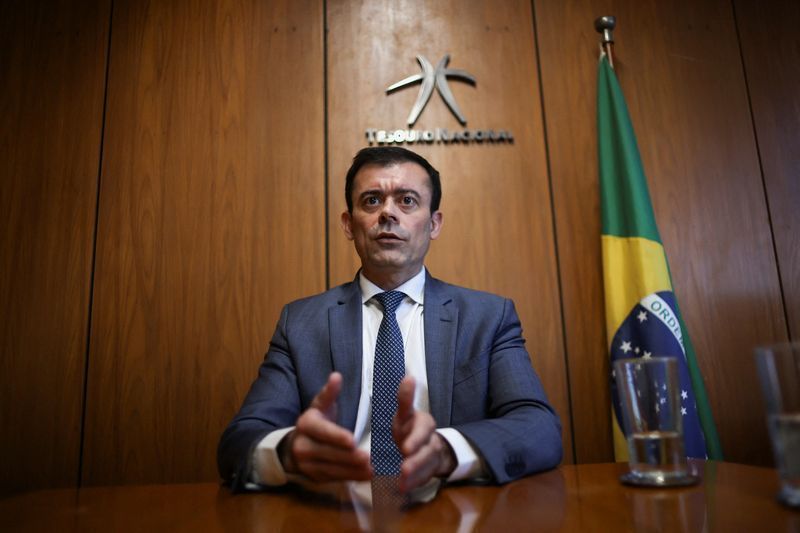
Brazil’s federal government has asked the Senate to replace the current cumulative ceiling for overseas bond issuance with an annual limit of US$35 billion. The request would allow the Treasury to continue issuing debt abroad after approaching the existing US$100 billion cap.
According to single-source reporting by CNN Brasil, the government said foreign bond issuance had reached US$97.4 billion by April 2026. Without a change in the rules, the remaining headroom could interrupt operations planned for later this year.
A New Issuance Model
The proposal would replace the current cumulative ceiling with a recurring annual authorization. The Senate raised the limit from US$75 billion to US$100 billion in 2024, also at the government’s request.
The government presented the change as part of a debt-management strategy focused on financing costs and long-term risk. It said overseas operations would diversify the investor base and expand Brazil’s presence in European and Asian markets.
The Treasury also cited the importance of consolidating a dollar-denominated interest-rate curve. Such a benchmark could help the federal government price its own foreign borrowing and provide a reference for Brazilian companies seeking to raise funds overseas.
Foreign-Currency Debt
The government said debt denominated in foreign currency currently accounts for 3.8% of Brazil’s total public debt. Its stated plan is to increase that share to 7%.
The message also compared Brazil’s external debt stock, equivalent to 2% of gross domestic product, with figures of 7.6% for Chile and 4.8% for Mexico. The government used the comparison to argue that Brazil has room to expand foreign borrowing.
The figures refer to different measures: the 3.8% and 7% figures concern the share of public debt in foreign currency, while the 2% figure measures external debt against economic output. The government’s argument is that a relatively limited foreign-currency exposure leaves space for additional overseas fundraising.
Senate Procedure
The request was signed by Rogério Ceron, executive secretary of the Finance Ministry, and sent to the Senate. It still awaits referral by Senate President Davi Alcolumbre, of the União Brasil party, to the Economic Affairs Committee, known by its Portuguese acronym CAE.
The committee will need to consider the proposal before the Senate can deliberate on it. The source material does not indicate when that referral or a possible vote will occur.