


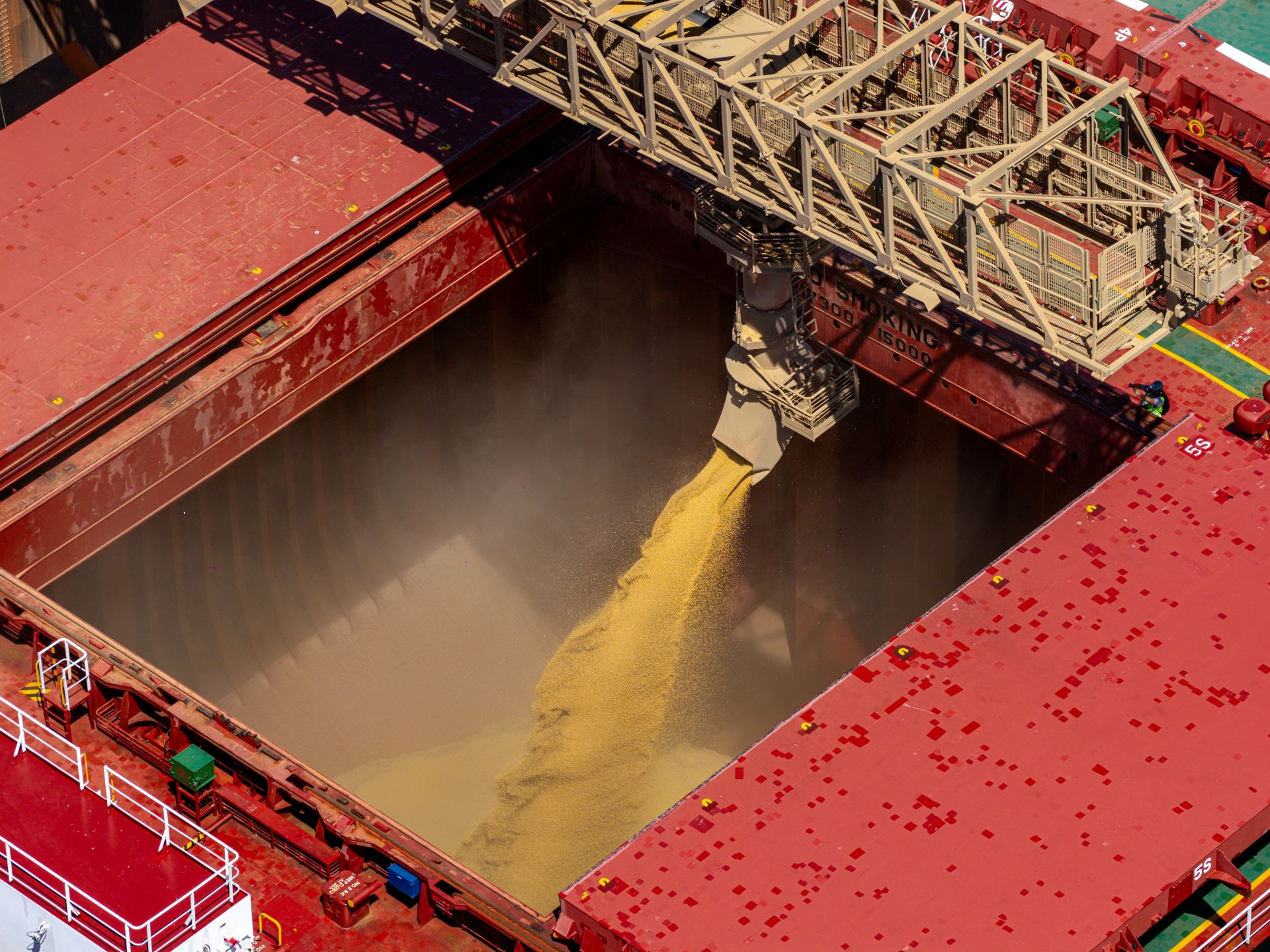
Data released in June shows China self-sufficiency push — outlined in its 15th Five-Year Plan adopted in March — is already cutting Brazil soybean shipments.
China imported 9.96 million metric tons of soybeans from Brazil in May, down 17.7% from 12.1 million tons in the same month last year, according to customs data reported by Reuters. Total Chinese soybean arrivals also fell, while imports from the United States rose slightly from a year earlier.
The figures do not mean Brazil has lost its place as China’s main soybean supplier. They do show why Brazilian agribusiness investors are watching Beijing’s food-security policy more closely.
What China Wants
China’s 15th Five-Year Plan renews Beijing’s focus on agricultural autonomy. According to InfoMoney’s account of a Santander report, the plan centers on farmland protection, seeds and strategic reserves, with a mandatory grain-production capacity target of about 725 million tons and an objective of reaching 85% seed autonomy.
The plan does not set specific targets for soybeans or beef. Santander analysts read that omission as a sign that China’s dependence on imports in those segments is more structural and harder to eliminate than in other agricultural products.
For Brazil, soybeans are the central issue. InfoMoney, citing Santander, reported that China’s soybean self-sufficiency remains near 16%, and that the routes available for Beijing to reduce soybean imports substantially by 2030 look unreliable.
Brazil’s Cost Advantage
Brazil remains the largest force in global soybean trade. In 2025, according to the Santander figures reported by InfoMoney, Brazil supplied about 74% of the roughly 112 million tons of soybeans imported by China.
Santander’s argument is that Brazil still acts as the marginal-cost supplier to the world’s largest incremental soybean buyer. Its advantage rests on cheaper land, a double-crop farming system and a Brazilian real that has been weak against the U.S. dollar.
The bank said Brazilian soybeans delivered to China in 2024 carried a discount of about $55 per ton compared with U.S. soybeans. That price gap matters because China can seek more domestic production without easily replacing imported volumes at comparable cost.
The May data add a cautionary note. Reuters reported that China’s January-May soybean imports from Brazil were still up 6.7% from a year earlier, even though May shipments fell. U.S. shipments were down 42.5% in the same five-month period, despite the May increase.
Land Constraints
Santander’s report points to a practical limit inside China: arable land. Beijing’s “red line” policy restricts farmland conversion, leaving grain targets dependent on productivity gains rather than a simple expansion of planted area.
That creates competition between crops. Santander analysts said China’s attempt to raise both corn and soybean production strains the same land base, making a large operational advance in domestic soybean output less likely.
Corn is different. China has already cut corn imports from about 28 million tons in 2021 to about 2.6 million tons in 2025, according to the figures cited by InfoMoney. Brazil captured part of the marginal volume during that adjustment, but the direction of policy shows that Beijing can reduce dependence when the crop economics and land use allow it.
For Brazilian agribusiness, the risk is therefore uneven. China’s policy is real, and May trade data show it can affect monthly flows. But the available reporting also suggests soybeans remain one of the hardest commodities for China to replace at scale.