


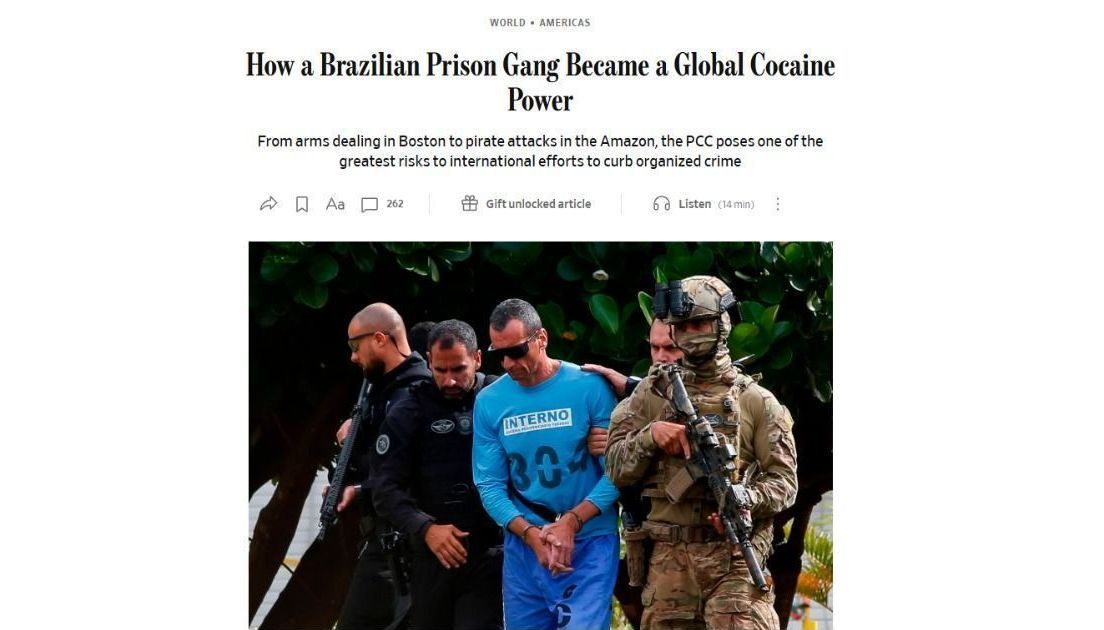
Brazil’s First Capital Command, or PCC, has grown from a prison gang founded in São Paulo state in 1993 into what Brazilian prosecutors and recent foreign coverage describe as one of the world’s most consequential criminal organizations.
Reports cited this week by Brazilian outlets, drawing in part on a Wall Street Journal profile, said the group now operates across nearly 30 countries and plays a central role in moving South American cocaine toward major European ports such as Antwerp and Rotterdam. The picture that emerges is not of a traditional cartel built around a single flamboyant boss, but of a decentralized network that prioritizes profit, internal discipline and operational discretion.
That model helps explain the group’s resilience. Even with historic leader Marcos Willians Herbas Camacho, known as Marcola, in prison, the PCC has continued to expand. According to accounts summarized by CNN Brasil and R7, the group has roughly 40,000 members and affiliates and has diversified beyond cocaine into illegal gold mining, cybercrime and other illicit markets. It has also built partnerships with foreign criminal groups, including European networks involved in port logistics and trafficking.
Brazilian reporting suggests the PCC’s influence is not limited to the underworld. Recent investigations described by Metrópoles point to alleged links between the organization and segments of the formal economy, as well as accusations of infiltration into state institutions. In one case, a protected witness cited in testimony to São Paulo’s military police internal affairs unit allegedly provided information about ties between members of the PCC and officers from Rota, the state police’s elite tactical force. The same witness, according to prosecutor Lincoln Gakyia’s testimony reported by Metrópoles, also helped reveal a 2023 plot to kill Senator Sergio Moro and Gakyia himself. Federal police later used that intelligence in Operation Sequaz, which targeted suspects accused of planning the attacks.
The broader allegation is that the PCC has become harder to contain because it combines territorial control, prison influence, business-like management and the ability to corrupt or co-opt actors on the margins of the state. Prosecutors cited in Brazilian coverage say earlier efforts to break the group by dispersing its leaders across different prisons may instead have accelerated its spread through Brazil.
The organization’s reach also extends into local criminal alliances. A separate Metrópoles report on the arrest in Greater São Paulo of an alleged gunman tied to Bahia’s Bonde do Maluco, an outfit described as allied with the PCC, illustrated how the group’s network can connect regional factions, fugitives and retail drug markets across state lines.
In the Amazon, according to the accounts relayed from the Wall Street Journal report, the PCC has exploited areas where the state is weak, controlling routes and imposing a form of parallel order in remote communities. Brazilian outlets also reported claims that the group launders money through apparently legitimate businesses, including real estate, gas stations, churches and fintech structures.
That combination of international trafficking, financial sophistication and institutional penetration is drawing greater foreign attention. U.S. authorities have already sanctioned operators linked to the group, and Brazilian prosecutors have pushed Washington to treat the PCC as a more serious transnational security threat. Debate has even emerged around whether the organization, alongside Rio de Janeiro’s Comando Vermelho, should be classified by the Trump administration as a foreign terrorist organization, though that remains a political and legal discussion rather than settled policy.
What is clearer is the underlying trend. The PCC is no longer just a Brazilian prison-born gang. It has evolved into a durable transnational criminal enterprise, able to move drugs, money and influence across borders while exploiting the weaknesses of both markets and institutions.
This article is based on multiple-source reporting from Brazilian outlets summarizing investigations, court-linked testimony and foreign press coverage.