


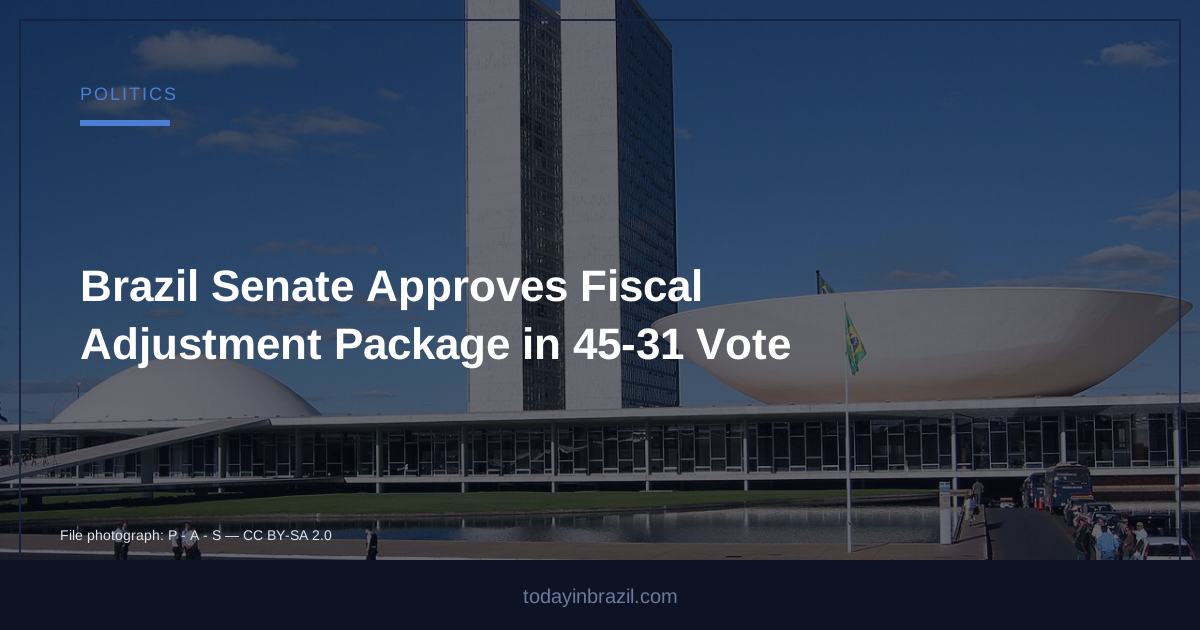
The Senate approved the text-base of the government's fiscal adjustment package (PLP 299/2026) on Thursday night by 45 votes to 31, with five senators not registering a vote. The complementary bill requires an absolute majority of 41 votes. Four amendments remain to be voted on November 17 before the measure moves to the Chamber of Deputies.
Vote shows expanded government support
The 14-vote margin represents a significant widening from the urgency vote earlier in the session, which passed 40-38. Senators from across the spectrum backed the text, including Damares Alves (Republicanos-DF), Plínio Valério (PSDB-AM), Izalci Lucas (PL-DF), and Styvenson Valentim (Podemos-RN). Opposition votes came from Flávio Bolsonaro (PL-RJ), Rogério Marinho (PL-RN), Sergio Moro (União Brasil-PR), and Tereza Cristina (PP-MS). Senate President Davi Alcolumbre (União Brasil-AP) did not vote per regimental rules.
Package details and fiscal impact
The bill allows the executive to contain spending growth, reduce tax benefits, and restrict tax compensations. It lowers the real spending growth ceiling from 2.5% to 2% in years when contingency measures are triggered to meet the primary deficit target. The government estimates a R$ 50-60 billion impact in 2027; rapporteur Eduardo Braga (MDB-AM) projects a R$ 45.1-56.1 billion improvement in the primary result.
Key provisions include limiting tax credit utilization to 80%, capping federal transfers to states for pension compensation at R$ 3 billion annually through 2030, temporarily reducing Kandir Law export compensation transfers to R$ 1 billion per year, and authorizing up to 40% of fund surpluses to be redirected toward constitutional obligations — excluding health, education, and social security.
Analyst warns coalition fragile for 2027
Political scientist Lucas de Aragão, partner at Arko Advice, told WW that the government will deliver only incremental fiscal measures as economic conditions deteriorate — currency depreciation, corporate bankruptcies, and Central Bank signals of sustained high rates. "Not to solve, to calm," he summarized. Aragão characterized Congress as a heterogeneous collection of parties, lobbies, and interests incapable of building consensus for structural reform, and said the same vote would fail in 2027. Measures such as dividend taxation or levies on CRI, CRA, LCI, and LCA instruments would lack sufficient Senate support next year.
Next steps
The four pending amendments will be voted November 17. If approved, the bill proceeds to the Chamber of Deputies, where the government must replicate or exceed the Senate coalition to enact the adjustment.